

Reading Recommendations Based On Your Favourite Fantasy Novel
Something FUN this week

Welcome to my Substack. Here you’ll find articles on everything from literature and reading to how we engage with our world through art. Right now you can get an annual subscription for 25% off for a full year. The summer sale lasts until August before returning to normal prices!
I’m also introducing a student discount! If you have an institutional email address, you get 20% off any paid subscription tier for as long as you are subscribed. I know it can be difficult to shell out cash when you’re in school, so I wanted to make it as affordable as possible for those of you in school.
I’m a die-hard fantasy fan. I’m not sure if it’s because I grew up in the mid-2000s and early 2010s, when just about every young adult and children’s novel was set in some fantasy world or dystopian future, or if it’s just because I’m an escapist by nature.
Either way, I love fantasy novels. When I have spare time to read outside of PhD study, I read fantasy. Something I’ve been thinking about a lot recently—whether that’s my brain making connections just because that’s how I’m wired or if it’s because of my quals readings—is how many of the fantasy novels (usually written off as “less literary”) that I know and love have grounding in or thematic relationships with some of the “great books” you find sitting on the shelves at the used bookstore. Or on a syllabus for a canon-heavy class. Think about it: there’s no Lord of the Rings or The Hobbit without Beowulf or the Eddas. Neither is there Dune without Lawrence of Arabia. And yes, there is no A Court of Thorns and Roses without Charles Perrault’s 17th Century book of Fairy Tales.
So, as a gift to you, my dear readers and friends, instead of giving you yet another list with long and heavy reading recommendations, I’ve decided that this week, I’m going to give you something fun. Some of these are connections I’ve made myself, others are referenced intertextually or by their authors. But there is a relationship at play; a dialogue across time that points toward the generative nature of fiction. Stories beget other stories. How opaque the relationship is between two stories is entirely at the whim of the author.
That being said, my definition of fantasy is quite broad. In my mind, fantasy encompasses not just massive worldbuilding systems like those of Sanderson or Rothfuss, but also science-fantasy, like Dune, because why not, and light fantasy, like the Shadowhunters books (which is also urban). So, I suppose, if it’s speculative, I’m including it. Go ahead and tell me the title is clickbait. I wanted this one to be broad.
The list is split into three sections: Children’s Literature, YA Literature, and Adult Literature. But the list is not exhaustive. I also will say this is a reading list, not a list of novels, because I cannot help but recommend some marvelous poetic works here, too.
Enough waffling. Let’s do this! This post is long due to the images, so read it in-app for the full experience.
Children’s Literature
The Dark is Rising and Sir Gawain and the Green Knight
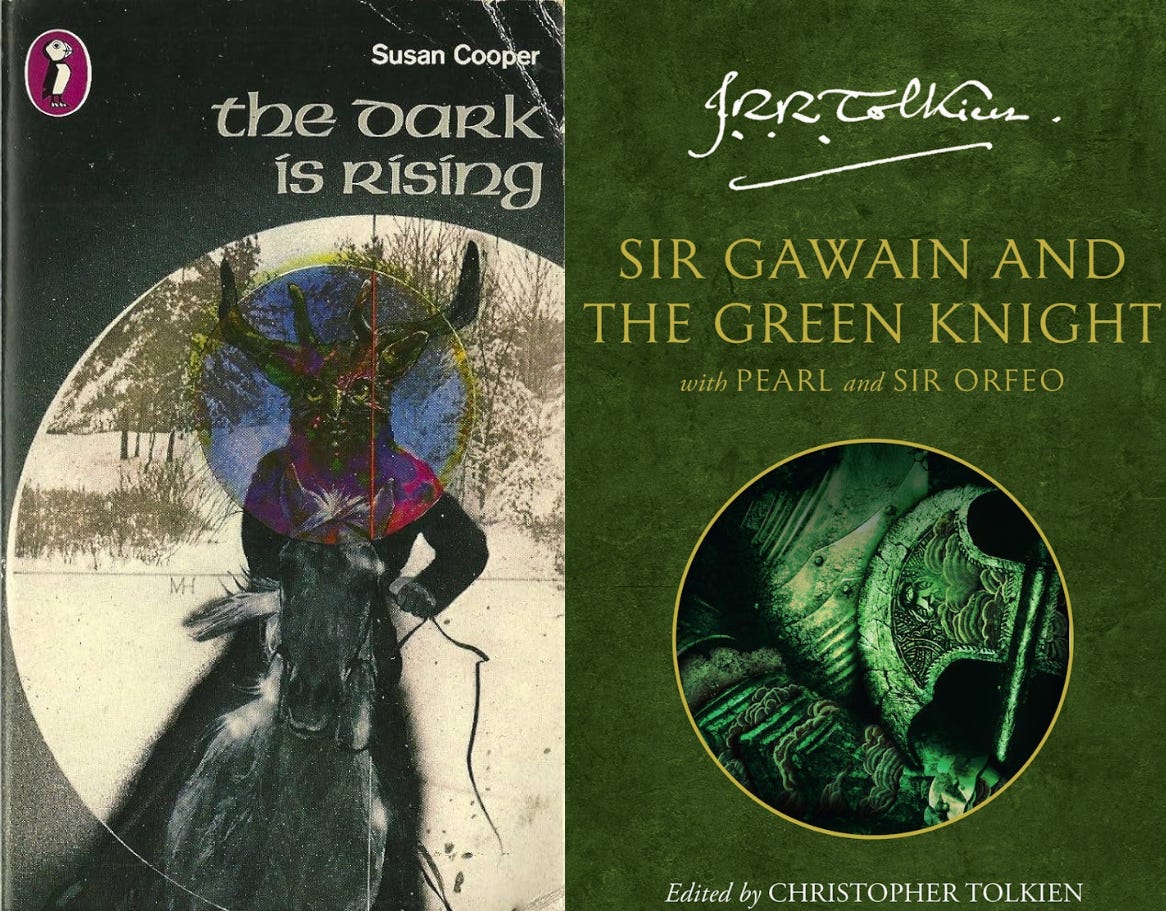
Susan Cooper’s Dark is Rising series has everything a child growing up in the English countryside could dream of: portals, magic, folklore, quests. Like Sir Gawain and the Green Knight, the series begins at Midwinter. As Will Stanton must navigate the relationship between dark and light forces, all while shrouded in the green and grim folklore of the English countryside, so too must Gawain navigate the relationship between a once-pagan world and a now-Christian world. Susan Cooper pulls from Arthurian and English folk-mythology to create her characters, and I think the most clear dialogue between the two is found in the characters of Herne the Hunter and the Green Knight. They descend from the same roots: a kind of personification of nature, of midwinter, and the cyclicality of existence.
The Chronicles of Narnia and Paradise Lost
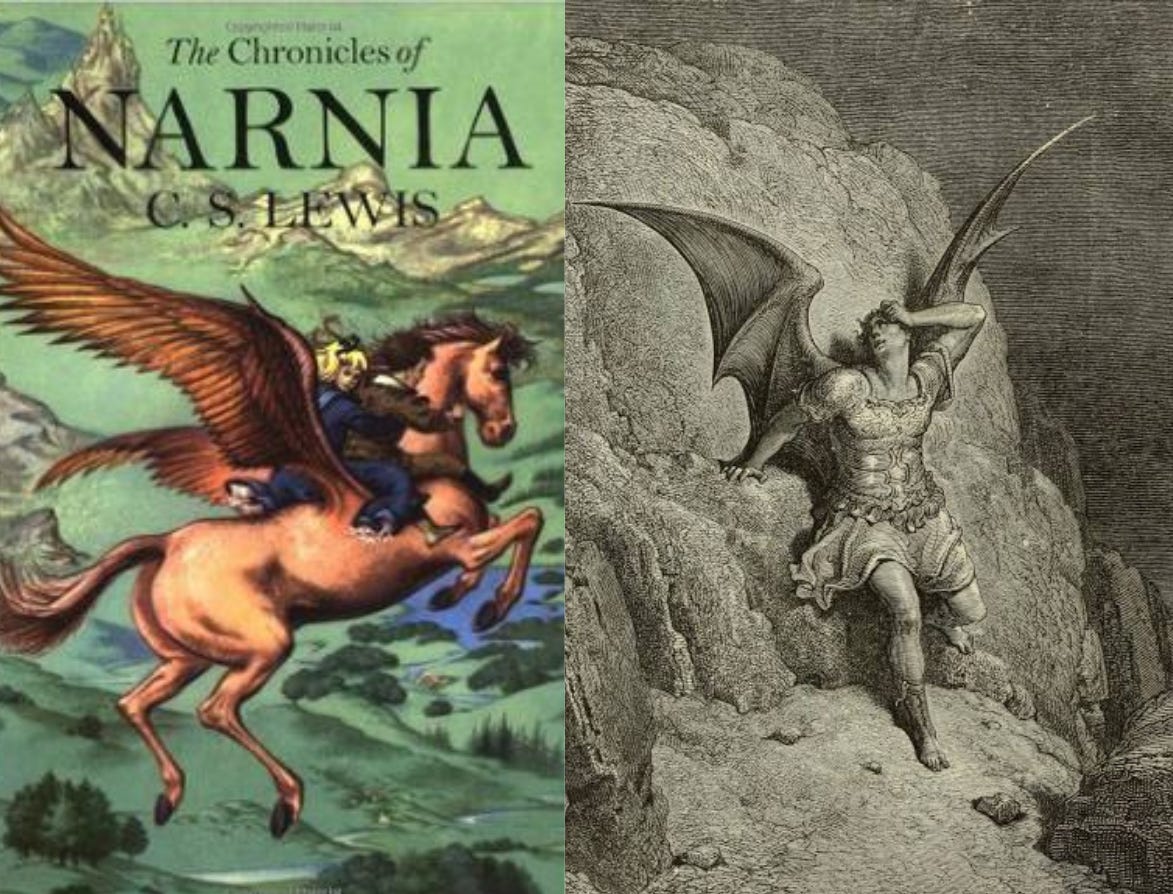
I thought of this not long after reading Lewis’s Preface to Paradise Lost, so I suppose it was a bit of an obvious choice. We all know that Narnia is a book that doesn’t shy away from its relationship to theology, but I think what connects Paradise Lost and Narnia is that they both run along the same kind of symbolic track. We have a temptation theme: Eve with the apple and Edmund with the Turkish Delight. We have a war between forces of darkness and light. We also have motifs of sacrifice and return (Lion Jesus!). However, while the themes follow those tracks, they also diverge in places. I don’t think the White Witch is made to be sympathetic, and that’s largely because most children’s literature struggles to depict sympathetic villains, whereas Milton’s Satan is traditionally figured as a sympathetic figure because he represents Milton’s own failures during the Regicide.
Alice in Wonderland and Gulliver’s Travels
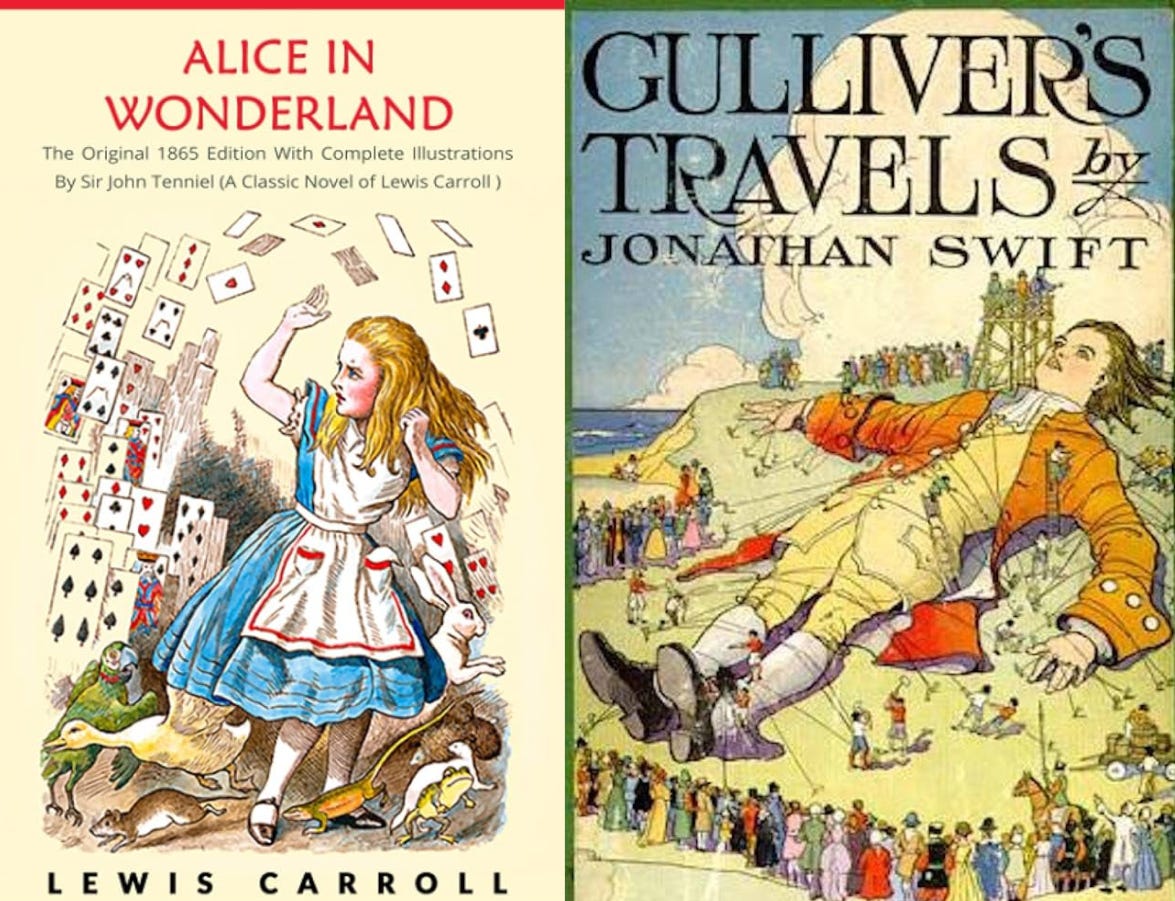
You might be able to trace a relationship here: rationality vs absurdity. Both are, essentially, travelogues that place a narrator within a strange world where things neither make sense nor conform to social logic. In Swift’s case, he satirizes through absurdity 17th-Century social life and Enlightenment logic; for Carroll, the same goes for Victorian social life and logic. Alice is far more whimsical, but it follows from the same literary inheritance of using satire and absurd humor to poke at social convention.
Young Adult Fiction
The Infernal Devices and A Tale of Two Cities
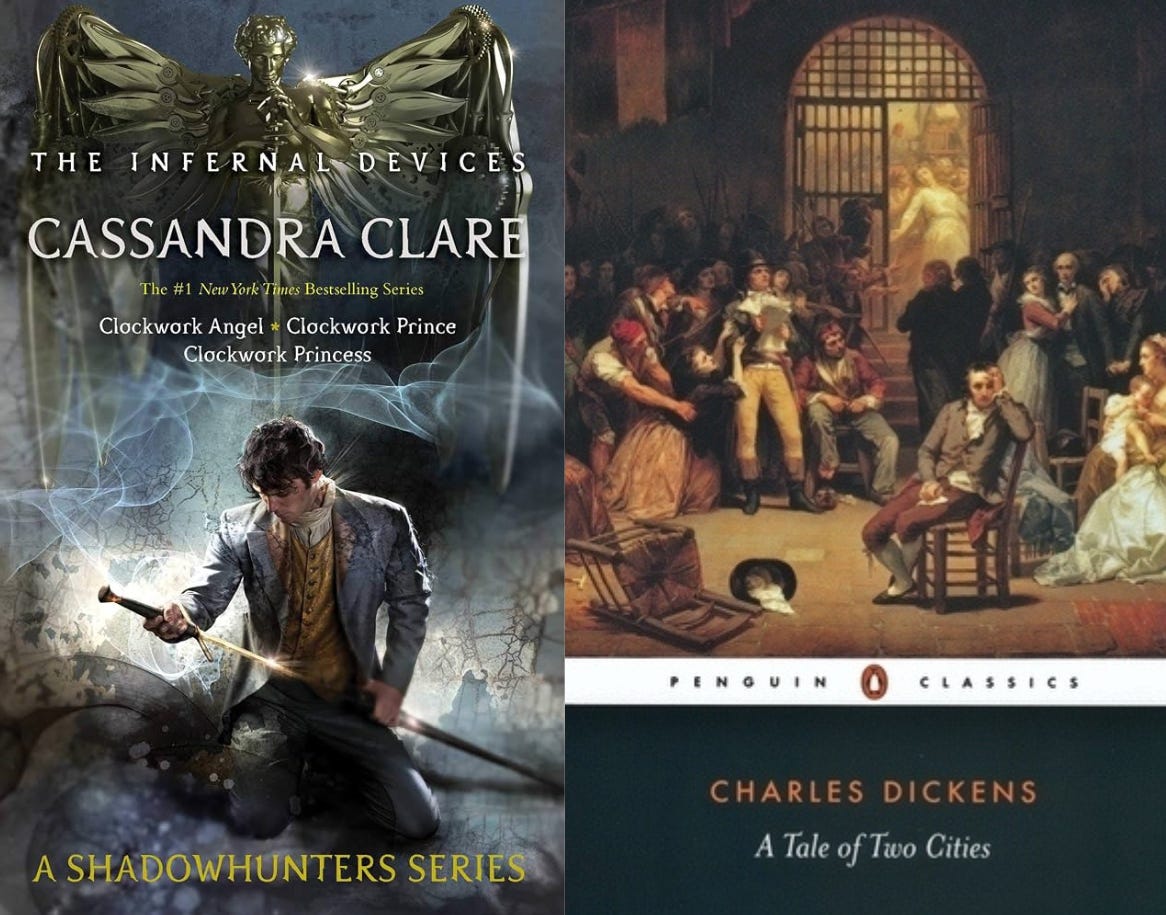
If you’ve read Cassie Clare’s Infernal Devices series, you know how important A Tale of Two Cities is to the romantic relationship between two of the characters. However, the intertextual relationship between the two is also built upon the romantic plot of Dickens’s novel. The ending of Dickens is enacted in the respective sacrifices that Jem and Will make in Clockwork Princess (I still sob). I’d also recommend Paradise Lost, again, to any Shadowhunters fan. The novels always refer back to Milton, almost incessantly. But the image of the shadowhunter as a “fallen angel” with more morally grey characteristics can be connected to how Satan is presented in Milton.
Shadow and Bone and Doctor Zhivago
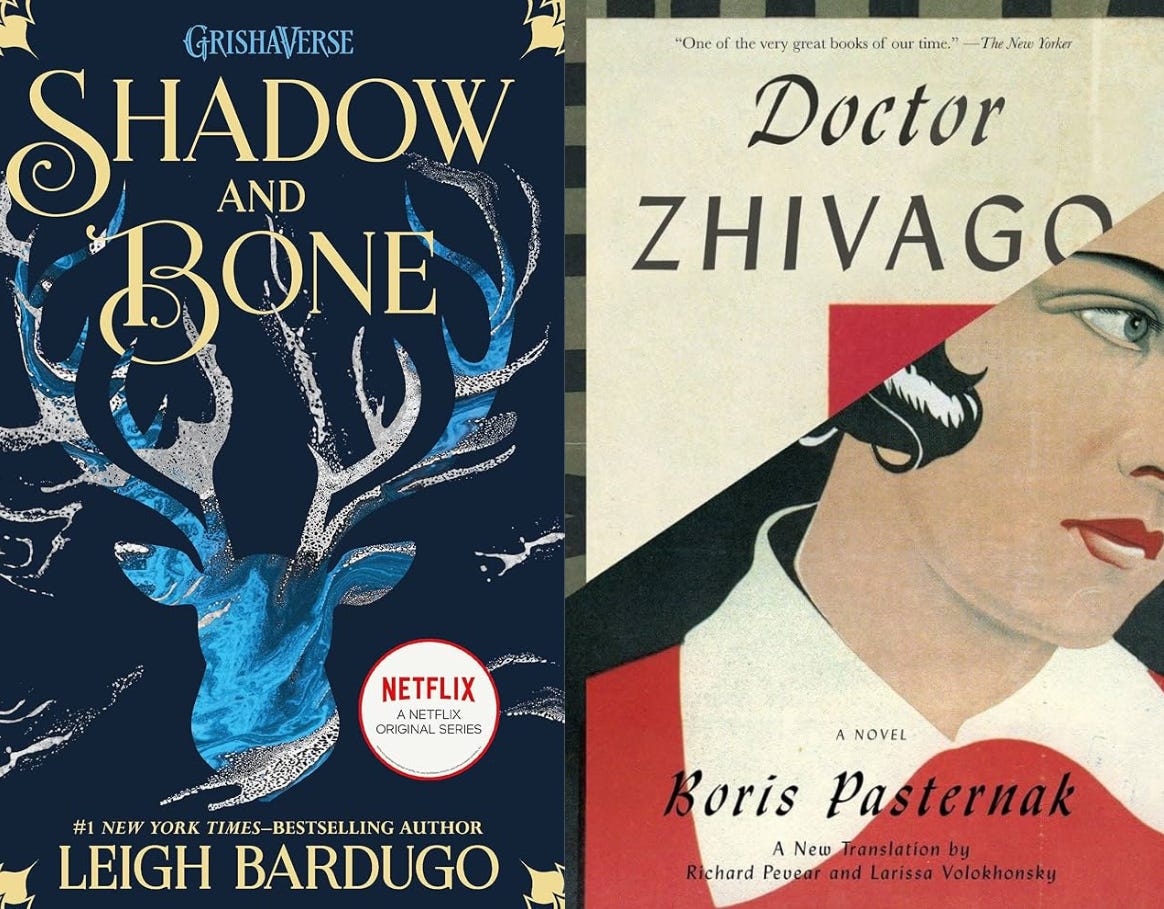
This one is fun. For Pasternak, the real ideological upheaval of the Russian empire as it rots is the background for the romance, whereas in Bardugo’s story, it is Ravka that acts as a kind of fantasy analogue for Russia. The romance is secondary to the political or ideological plot, but they are fundamentally inseparable from each other in both novels.
Twilight and Wuthering Heights
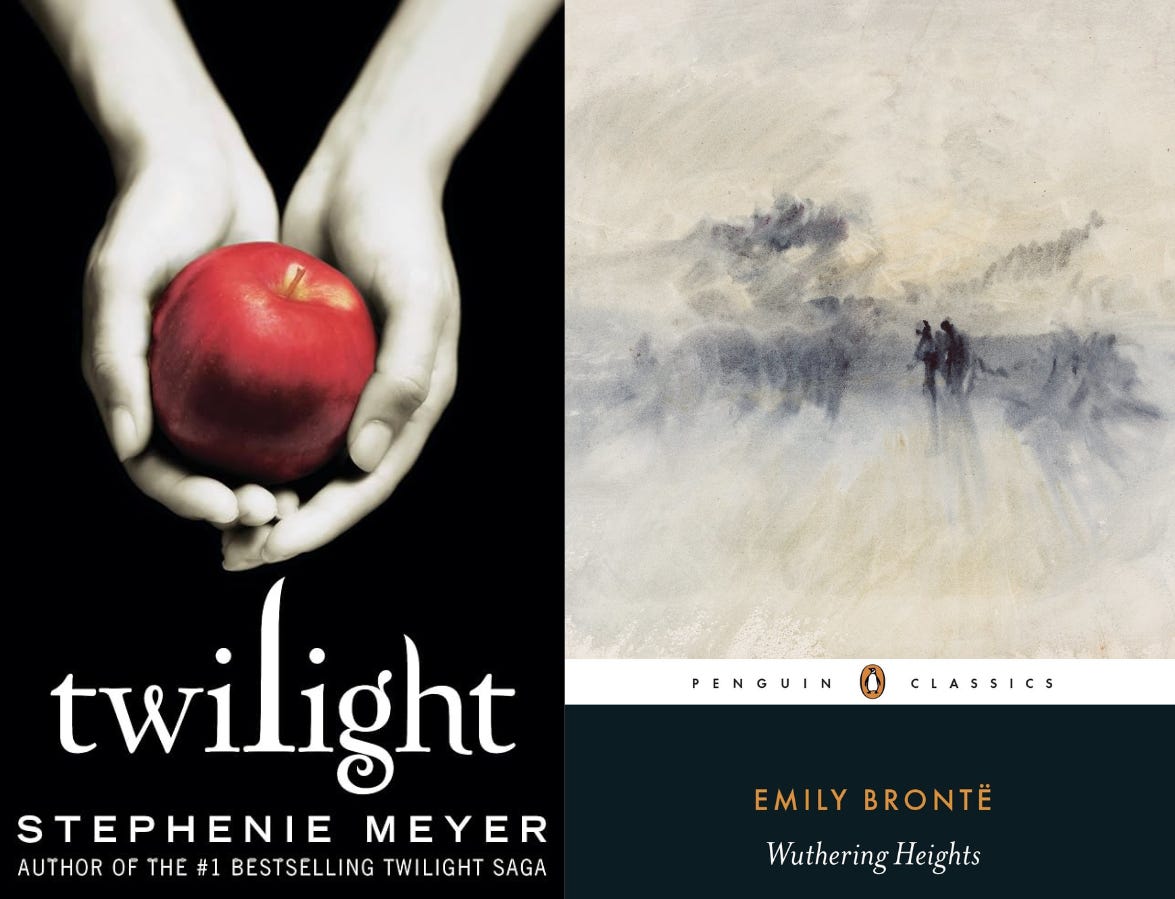
Okay, okay. This one is kind of whack, but hear me out. You have a moody, atmospheric location; you have a “forbidden” romance between a young woman and the “other”; you also have the tension between the Cullens and the Werewolves. Twilight lacks the social criticism of Wuthering Heights, but it is most definitely cut from a similar cloth. I mean, come on, just look at the setting. In all seriousness, though, when we consider the relationship between the gothic romance of the Heights and the gothic/forbidden romance of Twilight, there are some genuine literary connections to make—also, the books bring up the novel constantly, so you can see a conscious effort on behalf of Stephanie Meyer to draw your attention to the relationship.
Adult Fiction
Dungeon Crawler Carl and The Wasteland
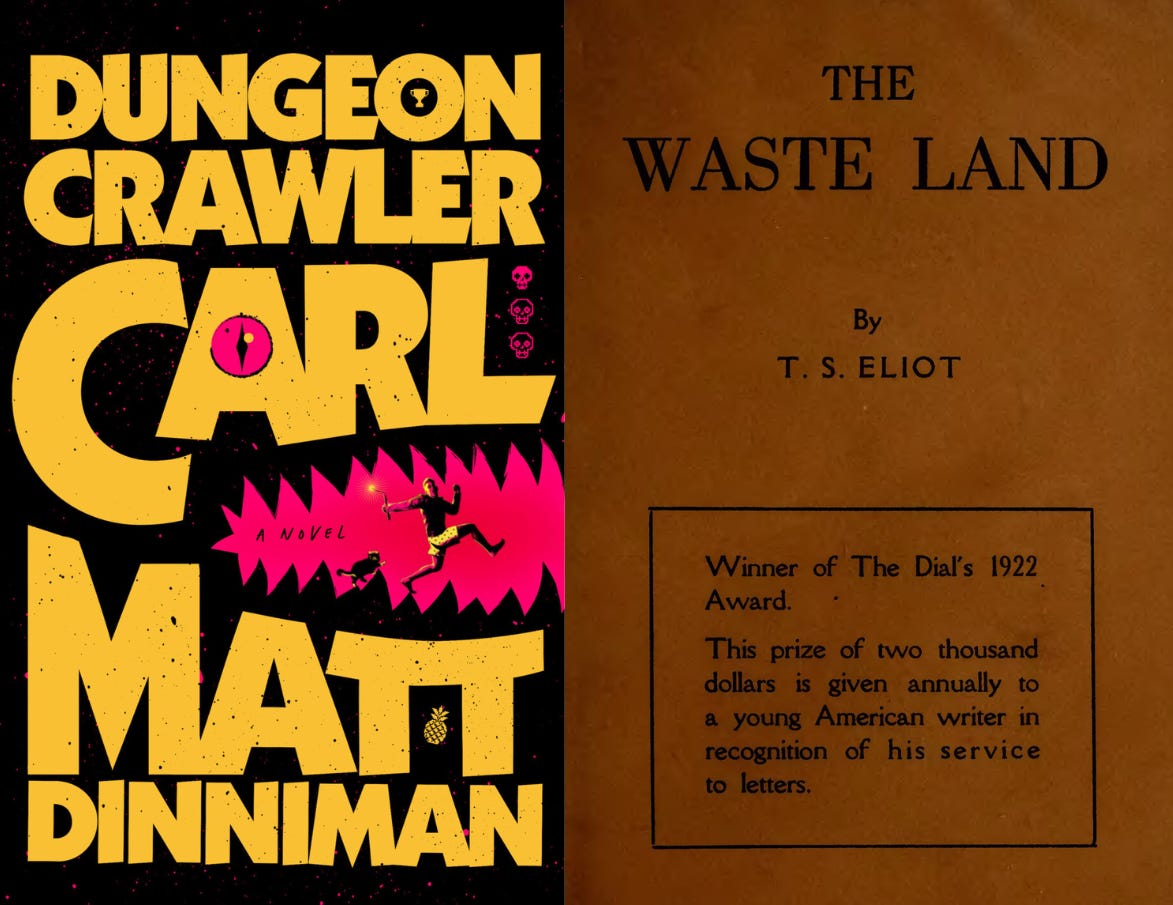
I have been reading the DCC series recently, so this has been on my mind constantly and is the thing that triggered this whole post. Initially, you might not think a LitRPG about a 27-year old Coast Guard vet and his (iconic) talking cat best friend/fellow crawler has anything to do with T.S. Eliot, but the similarities are there. T.S. Eliot writes of a world destroyed; a world that grapples with the rapid advancements in technology and warfare that led to WWI. He incorporates cultural and thematic elements that cross generations of literary history. Matt Dinniman is doing the same thing with his books: how do we cope with the rapid advancement of AI? What does it mean to be human in a world that is destroyed? Highly recommend as a companion piece.
Mistborn and Les Miserables
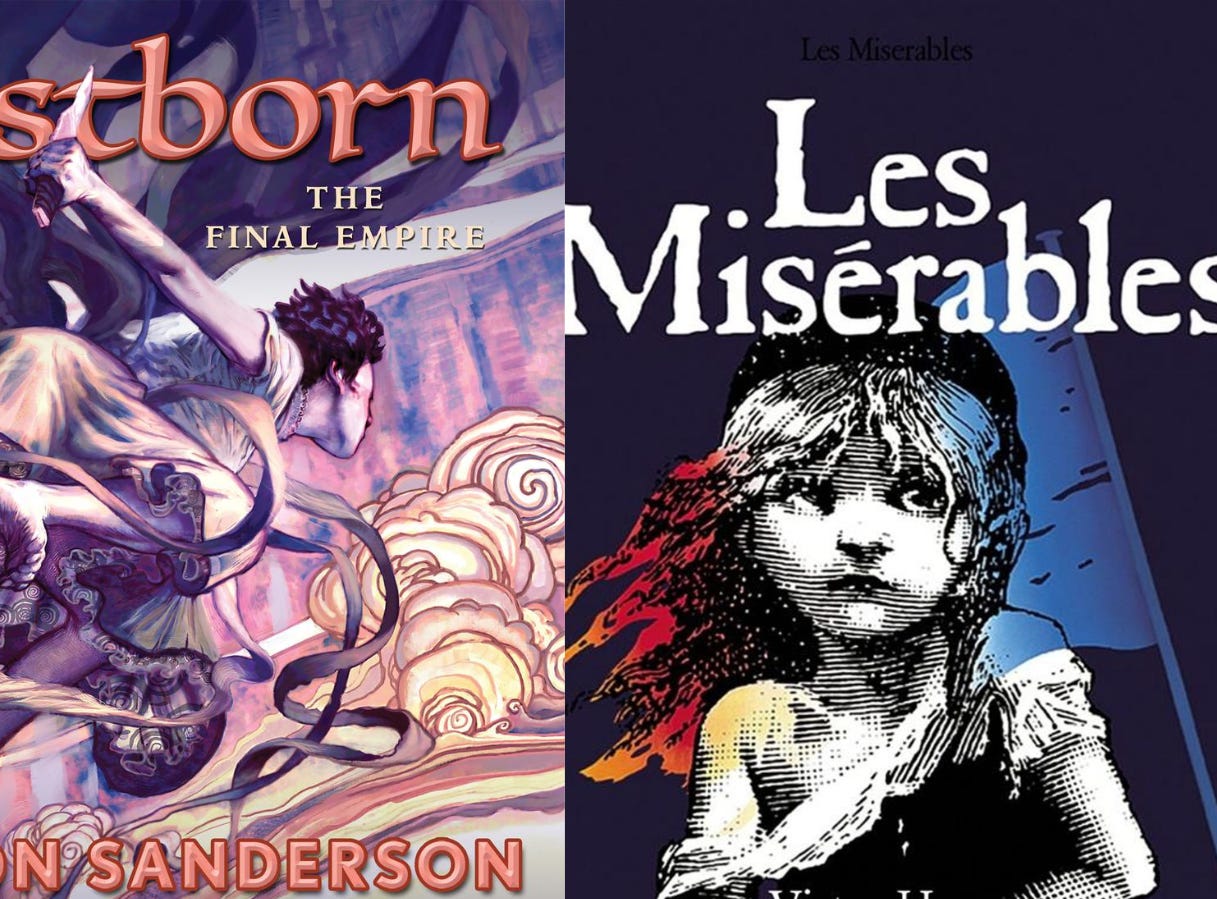
I don’t know if Brandon Sanderson has ever explicitly stated that Hugo is a direct influence on the Mistborn books (correct me if I’m wrong here), but given that Sanderson is a fan and the novels are inspired by Revolutionary France, the connection is not difficult to make. Both follow revolutions; both figure a messianic character who moves between varying social strata. Both books are also interested in what happens after the Revolution—how do social worlds, one real, one imagined, move on from their failures and successes?
The Broken Earth Trilogy (Fifth Season) and Beloved
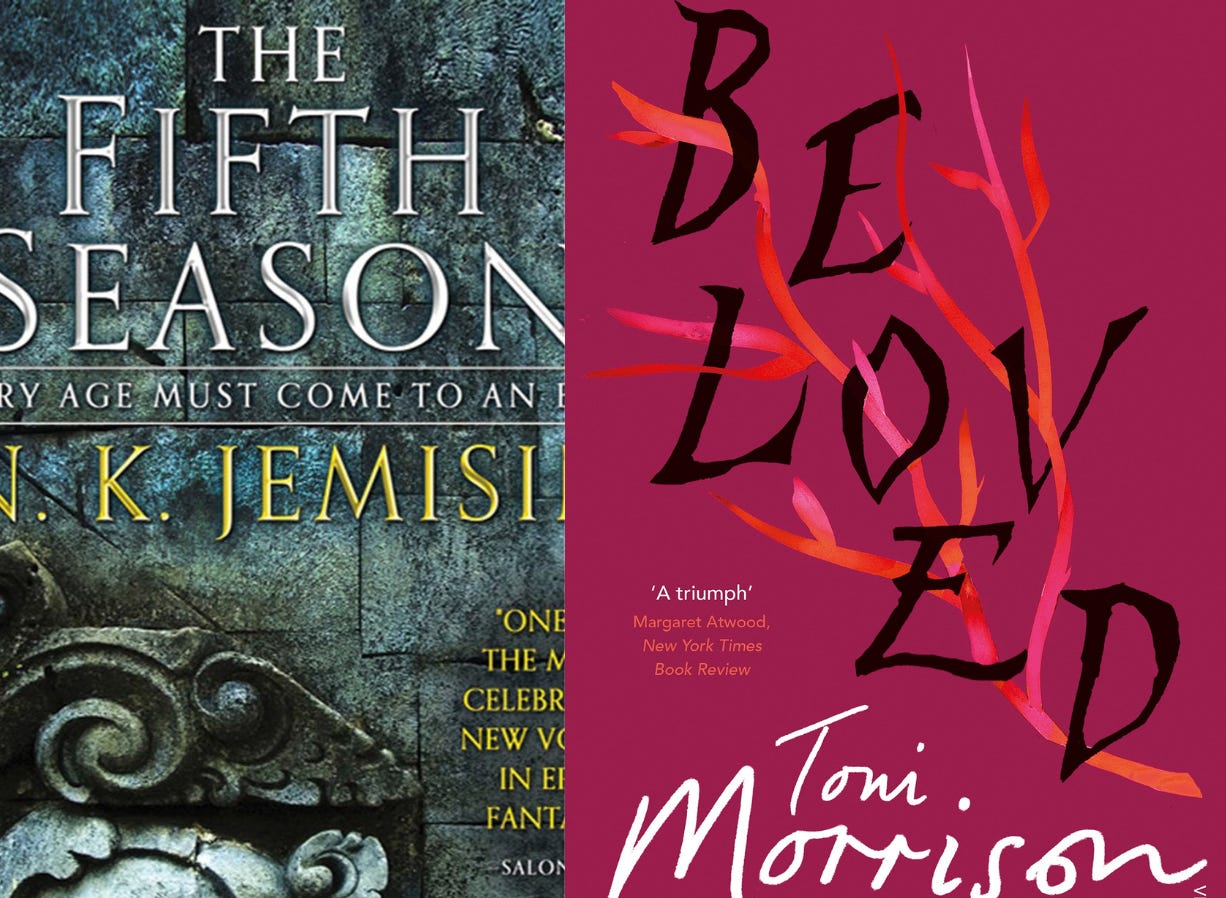
Jemisin’s series and Toni Morrison’s seminal novel both structure their plot around the same central themes: inherited trauma, motherhood. Both also use similar narrative devices, as well. Neither uses chronological time, but flit back and forth uses prolepses and analepses in service of the wider themes of trauma and womanhood in worlds where womanhood is placed below personhood. I think what makes the comparison here so beautiful is that Toni Morrison truly paved the way for authors like Jemisin to write so cleanly and honestly about the major social aspects that influence both of these novels. This recommendation comes from an article I read last year by Jess A. Goldberg, available at the link.
A Game of Thrones and The Prince
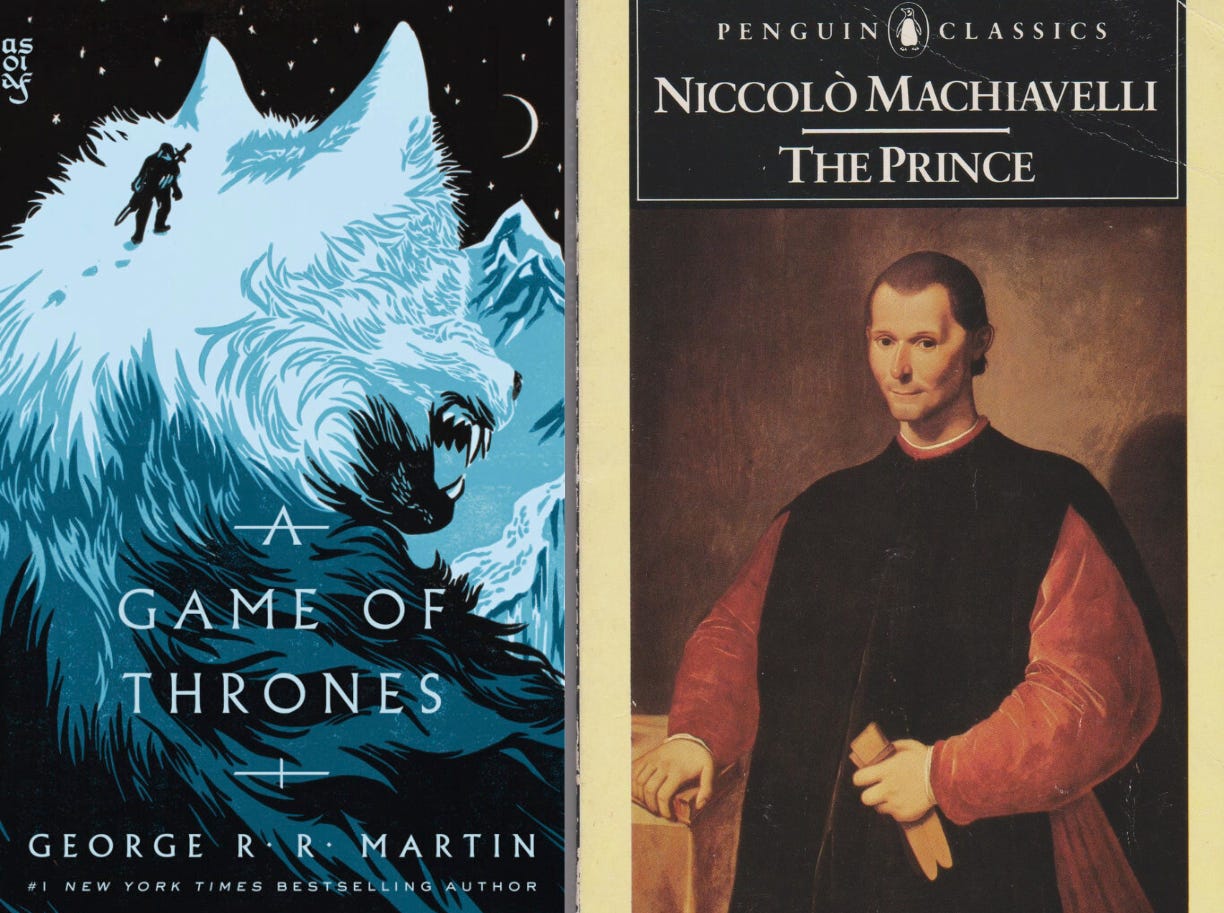
Okay, not fiction, I know, but the connection is there. GRRM has frequently cited the real-historical War of the Roses as the inspiration for the socio-political world of Westeros, but in a BBC documentary some time back, he also speaks to the influence of Machiavelli on the ASOIAF series. That much, I think, is obvious. I can’t help but find a great deal of pleasure in seeing genuinely Machiavellian characters at play in these books, and having the grounding in The Prince makes it all the more compelling. I also can’t help but recommend Shakespeare’s history plays here, like Henry V. I’d also hazard to recommend King Lear.
A Court of Thorns and Roses and Cupid and Psyche
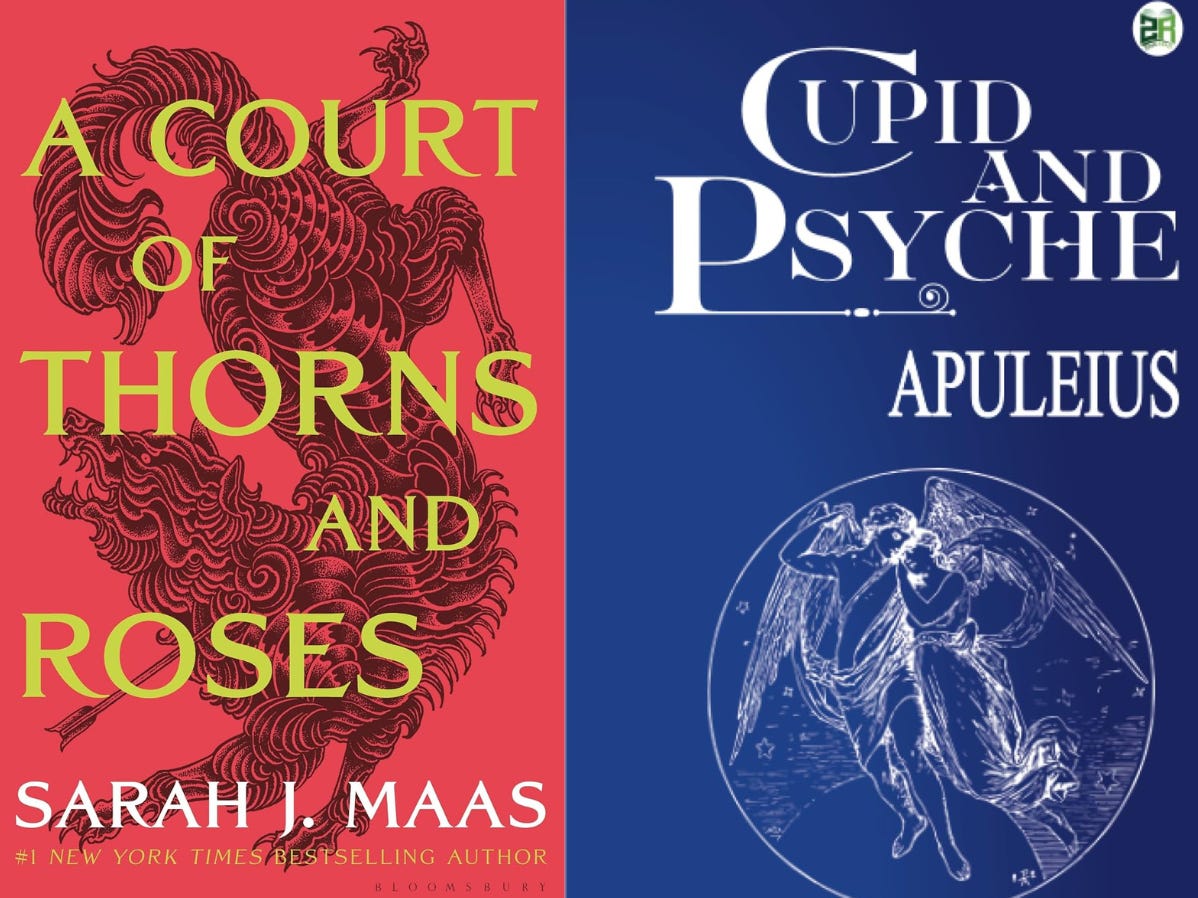
The clearest line of literary inspiration for Maas’s series is Beauty and the Beast, but the threads of the story can be traced back to the myth of Cupid and Psyche. Apuleius’ Metamorphoses (not to be confused with Ovid, or with Kafka) tells the original story (and is full of other, wonderful myths) of a king and queen with three daughters, like Maas’s Archeron family, one of whom, Psyche, is married off to a non-human being. She anticipates a horrible fate in Cupid’s home, but instead enters into a world of pleasure, beauty, etc. You see the connection. Myths and fairytales are often intertwined like this: nearly all fantasy can be traced back to the oral stories that have been told across generations of history.
Okay, What’s the Point of This List?
This is what I mean when I say that fantasy is in dialogue with other literary sources. As with all art, nothing is ever created in a vacuum. “Switching off” to read some fantasy as a form of escapism doesn’t really happen, because when you read, your brain is always making these connections. I wouldn’t have made this post if it weren’t for Carl and Donut, and likewise, I’m sure plenty of you can make connections between the novels I’ve talked about above and other literary works.
The joy of reading widely and across genres is that you are better enabled to see the threads of inspiration and dialogue that come with adapting old stories for new times. There is a lot of talk online right now about what Chris Nolan got “wrong” or “right” with his adaptation of The Odyssey, but I think it points to a larger dialogue we could be having about what it means to tell stories and how we go about seeking inspiration from the old things—the infamous and notorious pieces of myth and lore in our civilization—and make them new; make them “suit” the world we now inhabit.
Fantasy is a joy to read, and to be able to find connections between the silly little book you’re reading right now because it’s popular and a myth a poet sang 3000 years ago is a true joy. We have always and will always seek the escapist route to make sense of the difficult things in the world. There is value in that. Value in using monsters, gods, and magic to come to terms with the same thing everyone else comes to term with every time they read: the things that make us, conscious and emotive, human.
FURTHER RECOMMENDATIONS:
If you’re interested: Red Rising and The Aeneid are a fantastic pairing, as is The Wheel of Time with The Bhagavad Gita. Same goes for just about any Tolkien with Beowulf, The Wanderer, and The Prose and Poetic Eddas.
HOUSEKEEPING:
Marginal Notes 1.5: Against Nature will be released on Monday. I’m currently taking a few days off for my own sake and heading down to San Diego to spend some time with my dad.
This is fantastic, as always. I can’t add much as far as discourse goes since I’ve only read very few of the fantasy works mentioned but I’ve enjoyed this exploration nonetheless.
Interestingly, Lewis also wrote a book that strongly relates to Cupid and Psyche. It's called Till We Have Faces. I read it in my early teens, which was far too young to fully understand the novel. But from what I can remember, it was good.
On an unrelated note, your writing sounds so human! It was so refreshing to read this post.